
Se Habla Espanol | Nou Pale Kreyol
Click To Call: 239-537-0439
Click To Call: 239-537-0439
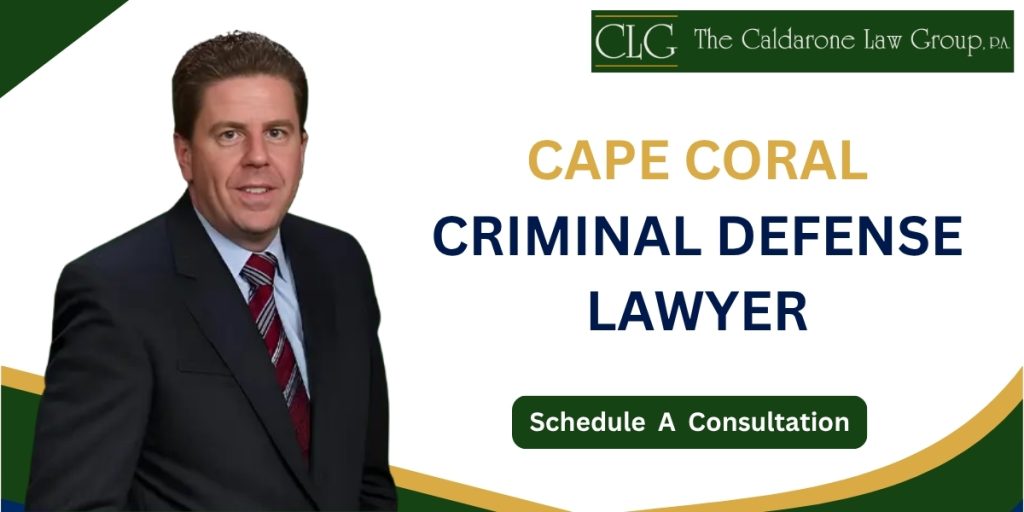
A Cape Coral criminal defense lawyer advocates for those accused of misdemeanors and felonies before the courts of Florida. An arrest or criminal investigation can create uncertainty about a person’s future, including concerns about employment, professional licensing, finances, and personal reputation.
The criminal justice system can be complicated with confusing legal procedures, important deadlines, and various constitutional rights at stake. Caldarone Law Group, P.A. helps those accused of a crime in Southwest Florida with navigating the criminal justice process and providing guidance on the legal issues that can arise at any stage of a criminal case.
The Caldarone Law Group, P.A. defends clients throughout Southwest Florida against criminal charges. Our firm’s founder, Justin P. Caldarone, is a former prosecutor who handled hundreds of misdemeanor and felony cases before opening his own law firm.
Justin’s experience as a prosecutor gives him a unique perspective on the criminal justice system, and he understands how cases are investigated, charged, and prosecuted. We handle a wide range of criminal offenses and Car Accident cases and represent clients in state and federal courts throughout Florida.
Following an arrest, a criminal case is likely to go through a number of procedural stages that could have a significant impact on the way the case is resolved. Florida Rule of Criminal Procedure 3.130(a) states that a person arrested and not otherwise lawfully released, in most instances, should be brought before a judicial officer within 24 hours of the arrest.
The accused individual may be placed in jail or detention, fingerprinted, photographed, and formally advised of the nature of the allegations. The court may also place travel or other restrictions on the case pending its disposition. Decisions made during these initial stages can affect later stages in a criminal case, such as plea discussions, evidentiary hearings, and trial.
An arrest does not necessarily result in the filing of formal criminal charges. Prosecutors often review the evidence before deciding whether the circumstances are sufficient to proceed with a prosecution. A prosecutor may review the police report, witness statements, physical evidence, video surveillance, and other investigative records.
Prosecutors may also assess the credibility of the witnesses and the ability to prove the allegations beyond a reasonable doubt. At times, an additional investigation may be conducted to assist in making a charging decision. When prosecutors decide that the evidence is insufficient, the charges may be reduced, declined, or otherwise resolved, depending on the circumstances of the case.
Criminal defendants have many protections under the United States Constitution. Constitutional rights include the right to silence, the right to counsel, the right to a fair trial, and the right to be free of unreasonable searches and seizures. The Fourth Amendment to the United States Constitution protects against unreasonable searches and seizures.
The Fifth Amendment also protects against self-incrimination. Constitutional rights apply to investigations, arrests, interrogations, and the courtroom. Violations of these rights by law enforcement may result in the suppression of some evidence or other remedies intended to protect the sanctity of the criminal justice process.
Criminal charges do not always result in a conviction for the alleged crime. Depending on the facts, charges may be reduced, dismissed, or result in a resolution through various programs. Weak witness testimony, lack of evidence, mistaken identity, constitutional violations, or procedural errors may impact the state’s ability to move forward. Florida law also provides certain diversion programs available to eligible defendants under the right circumstances.
The admissibility and reliability of evidence can be pivotal in criminal cases. Defense challenges may address whether evidence was obtained lawfully, preserved properly, or interpreted accurately. Attorneys may seek to suppress evidence obtained through an unlawful search or seizure. Florida Statutes § 933.07 contains requirements relating to the execution of search warrants, and compliance with procedural rules may become an issue in some cases.
Challenges may also involve witness credibility, forensic testing procedures, chain-of-custody concerns, or inconsistencies in law enforcement reports. The strength of the prosecution’s evidence often becomes a central issue throughout a criminal case.
The consequences of a conviction often do not end with a fine, probation, or jail time. Criminal convictions can present challenges when seeking employment, housing, school admission, or a professional license. Firearm rights, immigration status, and qualification for some government benefits may be at stake depending on the offense.
Florida State Courts System reported 503,317 county criminal cases and 152,742 circuit adult criminal cases filed in fiscal year 2023-24. These statistics show the number of criminal cases Florida courts handle each year. Every case depends on its unique facts, evidence, and legal issues.
Collateral consequences can remain long after a sentence has been served, so understanding the potential long-term consequences of criminal charges is frequently a key aspect of defense planning.
Criminal cases arising in Cape Coral are generally handled through the Lee County court system, although the specific courtroom, division, and hearing location may vary depending on the nature of the charges and procedural posture of the case. A defendant in such a case may appear in court for a first appearance, arraignment, motion hearing, plea proceeding, or trial in that courthouse.
Ultimately, the timeline and steps taken will be shaped by the charges themselves and the court’s availability. For anyone facing a criminal charge in Southwest Florida, grasping the local court’s customs and rules for criminal cases, including filing and procedural aspects, could prove beneficial.
Click To Call: 239-537-0439
Florida law allows some individuals to seek the sealing or expungement of a criminal record if specific requirements are met. Generally, a person cannot have been convicted of the offense, must not have previously sealed or expunged another record in most circumstances, and must obtain a Certificate of Eligibility from the Florida Department of Law Enforcement. Additional requirements apply depending on whether the person is seeking a sealing or an expungement.
Florida law divides crimes into two categories: misdemeanors and felonies. Misdemeanors are typically prosecuted in county court and usually involve a maximum one-year jail sentence. Felonies are generally prosecuted in circuit court and are more serious, leaving a defendant open to state prison sentences and other long-term repercussions. The offense level also influences court procedures, sentencing exposure, and the general complexity of a criminal case.
Florida’s justice system frequently handles criminal allegations. In 2024, USAFacts, which reported based on FBI crime statistics, showed a violent crime rate in Florida of 267 offenses per 100,000 population. Criminal charges can result from a variety of allegations, including those involving property, drugs, violence, and other conduct. Although crime data can provide a general context, the result of a criminal case turns on the specific facts, evidence, and legal issues.
Statements to police officers can be critical evidence in a criminal prosecution. A criminal investigation frequently involves interviews conducted by law enforcement and statements by witnesses or suspects. Constitutional issues such as the right to remain silent and the right to counsel can affect admissibility.
Courts consider the context of a statement and whether officers followed legal standards. Admissibility often depends on surrounding facts and the court’s application of constitutional and evidentiary rules in a particular case or criminal proceeding.
While jury trials get a lot of attention, most criminal cases never get to that point. The Florida State Courts System reports there were 156,827 circuit criminal cases disposed of in the state for fiscal year 2023-24. Cases can end with dismissals, diversion programs, plea agreements, or a verdict from a trial. Factors such as evidence, legal defenses, and circumstances can determine how a case proceeds.
Criminal cases are often shaped by far more than the allegations contained in an arrest report. Defense counsel may have to address evidence that is obtained through questionable investigative techniques, or even in violation of the constitutional rights of the accused. Regardless of whether a criminal case is resolved through negotiation, a motion or hearing, or a trial proceeding, a thorough analysis of the facts is often required.
At the Caldarone Law Group, P.A., we represent clients who have been charged with crimes all over Southwest Florida and provide zealous representation in both misdemeanor and felony cases. The potential consequences of a conviction can extend beyond fines or incarceration and may affect employment opportunities, professional licenses, and other aspects of daily life.
Understanding the charges, the available defenses, and the procedural issues involved can be an important part of responding to a criminal prosecution. Schedule a consultation today to hire a criminal defense lawyer.



” * ” Indicates Required Fields
"*" indicates required fields
© 2026 The Caldarone Law Group, P.A.• All Rights Reserved. Disclaimer | Site Map | Privacy Policy.
Digital Marketing By: 
*Images are obtained under license from Canva and other third-party stock image providers, with attribution included where required.
